F2 swept with F1 fixed, then F1 swept with F2 fixed
AbstractPhoneticians often need to construct stimuli in which specific acoustic cues are precisely manipulated while preserving decent speech quality. Classical synthesis and modern neural methods sit along a trade-off between precise parametric control and high fidelity, and neural synthesis typically demands more data than phoneticians can easily obtain. We present ARIS (Analytic Resonant Interpretable Synthesis), a neural source–filter model that pairs neural parameter estimation with deterministic DSP synthesis. Every control is a coefficient of the synthesizer, so F0, formants and the glottal source can be edited directly. On five small single-speaker corpora in three languages, ARIS resynthesizes speech with quality comparable to WORLD and edits single parameters more accurately than Praat KlattGrid, with negligible crosstalk between cues. Compared with HiFi-Glot, pre-trained on a large corpus and fine-tuned on the same data, ARIS scores slightly lower on predicted naturalness but reproduces the recordings more faithfully and manipulates them more precisely.
What is ARIS?
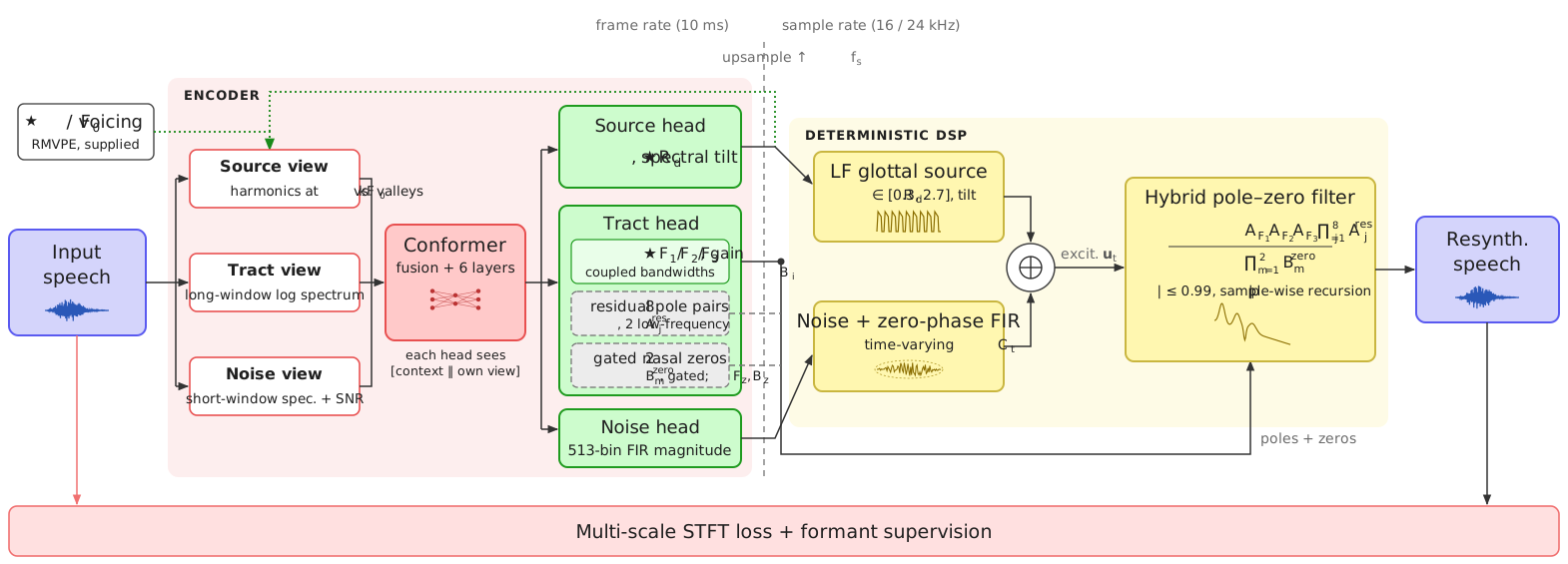
A neural encoder estimates frame-level controls; a deterministic source–filter synthesizer converts them back into speech. Every control is a synthesizer coefficient (F0, Rd, one resonator per formant), so each cue is edited directly, with a model trained on at most 1 h of one speaker.
★ editable · dashed: learned, not exposed
Objective results
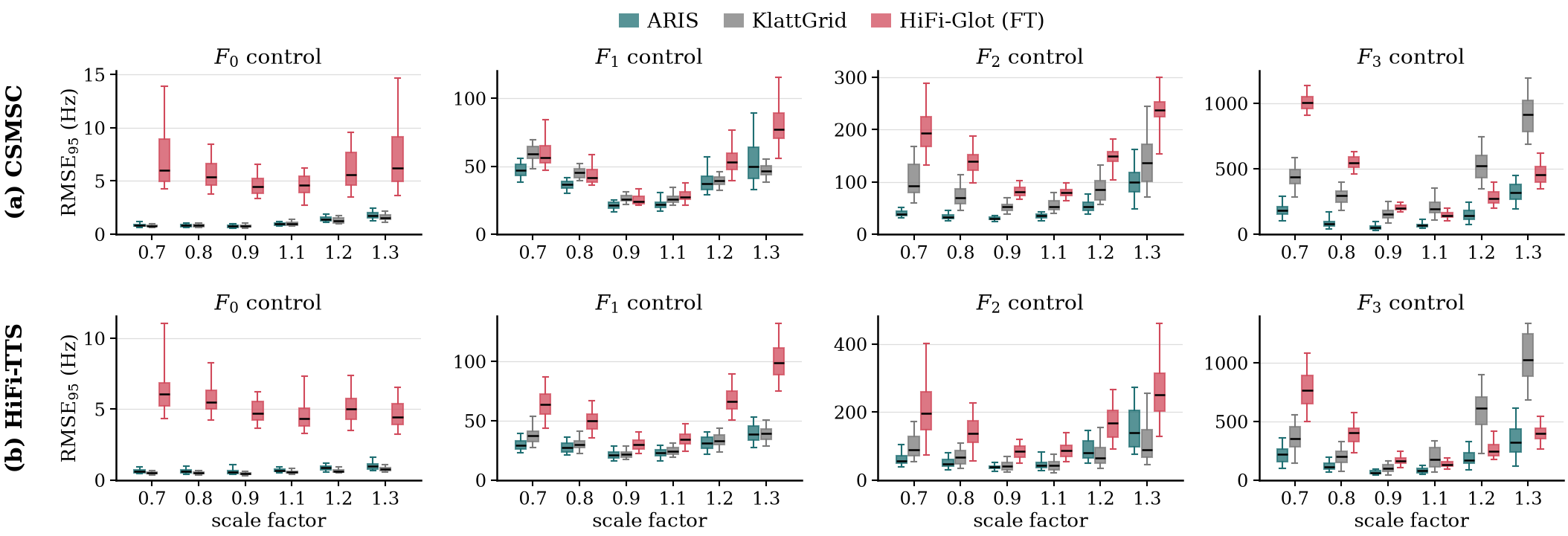
Error of the edited cue when F0–F3 are scaled by 0.7–1.3 (60 sentences per corpus).
Copy synthesis
Unedited resynthesis by each system. All files at −26 dBFS.
You don't know the middle classes as well as I do.
HiFi-TTS · 16 kHz · original
Scale
ARIS
KlattGrid
HiFi-Glot (FT)
×0.8
×1 unedited
×1.2
Scale
ARIS
KlattGrid
HiFi-Glot (FT)
×0.8
×1 unedited
×1.2
Scale
ARIS
KlattGrid
HiFi-Glot (FT)
×0.8
×1 unedited
×1.2
Scale
ARIS
KlattGrid
HiFi-Glot (FT)
×0.8
×1 unedited
×1.2
They dislike finality in this country.
HiFi-TTS · 16 kHz · original
Scale
ARIS
KlattGrid
HiFi-Glot (FT)
×0.8
×1 unedited
×1.2
Scale
ARIS
KlattGrid
HiFi-Glot (FT)
×0.8
×1 unedited
×1.2
Scale
ARIS
KlattGrid
HiFi-Glot (FT)
×0.8
×1 unedited
×1.2
Scale
ARIS
KlattGrid
HiFi-Glot (FT)
×0.8
×1 unedited
×1.2
Vowel & formant continua
One natural token, one control moved in equal steps. Values under each step are measured.
Mandarin vowel space ǎ → yǐ (Bark-interpolated F1–F2 trajectory)
ǎ → yǐ啊 (interjection) → 椅 ‘chair’
F024 · manipulated: F1,F2,F3 (Hz) · base token F024_a3
F1 and F2 move from the natural ǎ targets towards those of yǐ from the same speaker, with targets equally spaced in Bark.
details
F3 is also interpolated in Bark to avoid F2–F3 overlap near yǐ; F0 and source controls are held fixed. These are formant edits, not a complete reproduction of the natural endpoint vowel.
Mandarin vowel space ǎ → wǔ (Bark-interpolated F1–F2 trajectory)
ǎ → wǔ啊 (interjection) → 五 ‘five’
F024 · manipulated: F1,F2 (Hz) · base token F024_a3
F1 and F2 move from the natural ǎ targets towards those of wǔ from the same speaker, with targets equally spaced in Bark.
details
F3, F0 and source controls are held fixed, so the endpoint is an F1–F2 approximation rather than a full reproduction of wǔ. F2 cannot go below 700 Hz, the lower end of its range, so steps 7–9 have nearly the same F2.
MALD · manipulated: F1,F2,F3 (ratio) · base token LEMON
F1, F2 and F3 of ‘lemon’ are multiplied by a shared factor from 0.85 to 1.15.
details
F0 and source controls stay fixed, and the eight residual pole pairs are not scaled. This is a partial spectral manipulation, not a complete vocal-tract length transformation; a change in perceived speaker size is not established by this demo.
F0 is interpolated in semitones between natural dá and dǎ contours from the same speaker.
details
The contours are time-normalised to the base token's voiced span, with period-doubled frames in the Tone 3 dip bridged. The base token's spectral-envelope, voicing, duration and amplitude controls are held fixed; this illustrates an F0 edit, without a claim about which tone pair is most confusable.
Only the final voiced stretch of ‘now’ (at most 400 ms) receives an F0 edit.
details
Its contour is interpolated in semitones from the natural contour towards a curved rise ending 9 semitones above an anchor taken from the region's first 50 ms. F0 outside the region and the spectral-envelope, timing and voicing controls are held fixed; the demo does not measure statement–question judgements.
The model's frame-wise Rd control for sustained ā is scaled by factors from 0.6 to 1.6 through a shift on its logarithmic lookup table.
details
Values are limited to the table's range. F0, formant, noise-branch and duration controls are held fixed; H1–H2 and HNR below are measured outputs, not guaranteed monotonic changes or perceptual labels.
F024 · manipulated: noise gain (dB) · base token F024_ta1 (train split)
The gain of ARIS's spectrally shaped noise branch is shifted from −12 to +12 dB for tā.
details
Harmonic-branch, F0, formant and timing controls are held fixed. HNR is measured on the vowel, alongside pre-voicing energy relative to vowel energy (uv); the manipulation changes noise level rather than aspiration duration.